How I Would Use GPT-5.6 Without Wasting Intelligence
My practical model-routing workflow: Sol for the main work, Fable 5 to challenge important plans, Interplan for human review, and Luna for focused sub-agents.
OpenAI has released three GPT-5.6 models: Sol, Terra, and Luna. The official positioning is simple: Sol is the flagship, Terra is the balanced option, and Luna is the fast and affordable one.
But after looking at the cost and intelligence results, I would use them a bit differently.
For me, the interesting part is not choosing one default model. It is routing the work between two main models, then spending more intelligence only where it changes the result.
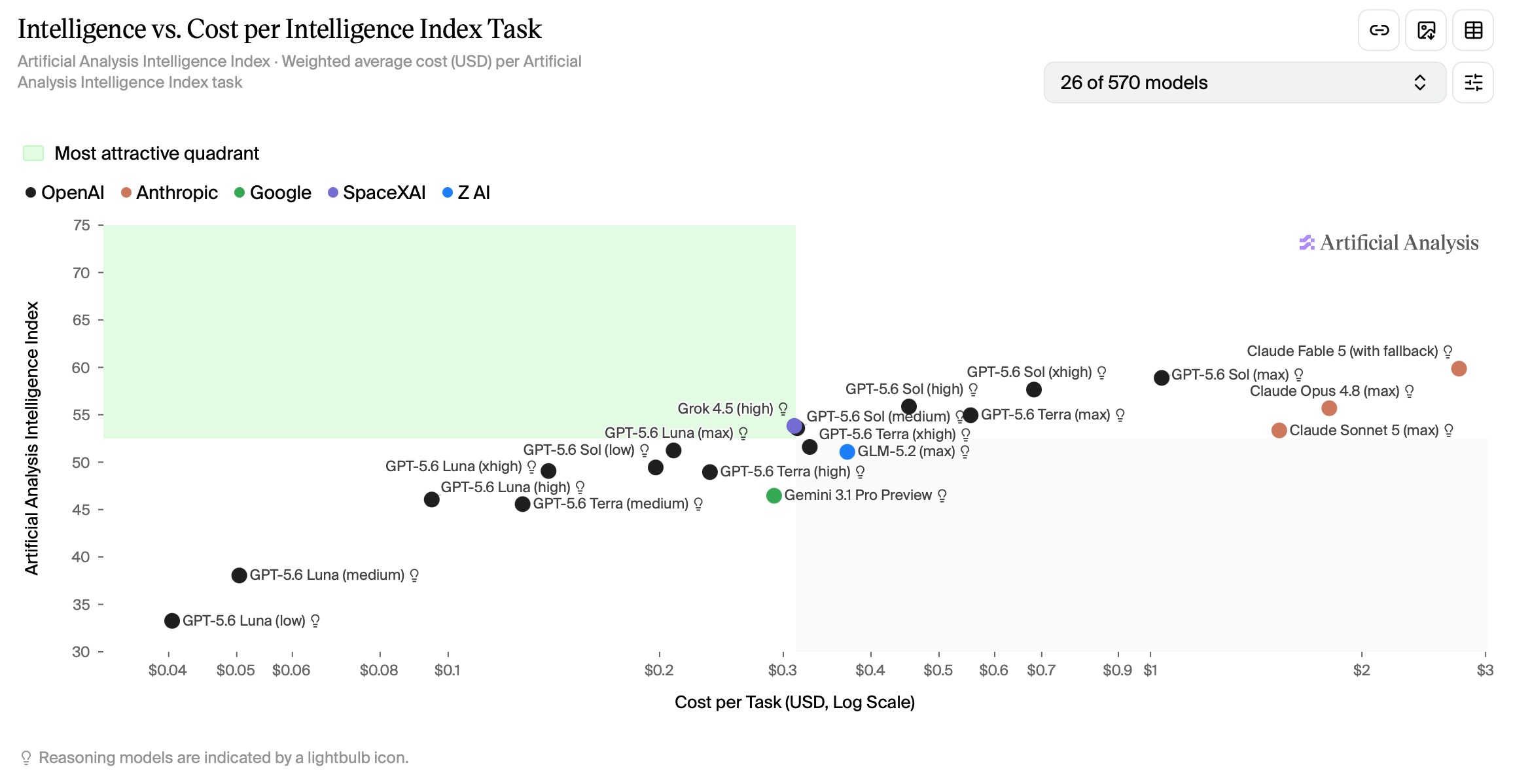
Intelligence versus estimated cost per task, captured from Artificial Analysis on July 10, 2026. This is a useful routing signal, not a substitute for testing models on your own work.
My two main workhorses
My default would be GPT-5.6 Sol with low reasoning effort.
It sits in a very attractive place on the chart. It is already strong enough for normal coding, writing, research, and tool use without paying for a long reasoning process every time. If the task needs more care, I would move Sol to medium.
Then I would use GPT-5.6 Luna with low or medium effort for focused sub-agent work: finding files, checking tests, summarizing documentation, researching one narrow question, or implementing a well-defined small task.
That leaves a simple routing rule:
Normal work                              -> Sol low
Work needing more care                   -> Sol medium
Narrow sub-agent task                    -> Luna low or medium
Hard reasoning and planning agent loops  -> Sol high, xhigh, or max
Hard coding subtask                      -> Sol low or medium as a sub-agent
OpenAI describes Terra as the balanced everyday model. I am not saying Terra is a bad model. But on this chart, I do not yet see a clear place for it in my own workflow. Sol-low gives me a better main workhorse (faster and cheaper), while Luna gives me the cheaper worker for narrower tasks.
That may change after real use. A benchmark is one view of performance, and the right routing decision depends on the codebase, the tools, the prompt, and the cost of a mistake. I would still run a small evaluation on my own recurring tasks before locking this into an agent configuration.
Brainstorm between models before writing code
The bigger opportunity is not the model picker. It is what happens before the first line of code.
For an important change, I would not ask one model to make the plan and then immediately implement it. I would make two strong models challenge each other first.
For example (Implemented as Agent Workflow):
- Ask GPT-5.6 Sol with xhigh or max effort to produce a complete implementation plan.
- Give the plan and the same source context to Claude Fable 5 at medium or high reasoning effort.
- Ask Fable to find missing requirements, weak assumptions, architecture problems, unnecessary work, and risks.
- Return the critique to Sol and ask it to respond with concrete changes.
- Continue for a maximum of 3-10 turns, or stop earlier when both models agree on one complete solution.
Use model disagreement before implementation, while changing the plan is still cheap.
The goal is not to let two models talk forever. The goal is convergence.
I would give them an explicit agreement contract. The final plan must include:
- the intended outcome and non-goals
- the files and systems likely to change
- the proposed architecture and important trade-offs
- implementation steps in dependency order
- validation, tests, and rollback
- open questions that still require a human decision
If they still disagree after ten turns, the unresolved points should be shown to me. That is more useful than forcing a fake consensus.
Fable 5 is expensive on the chart, so I would not use it as the everyday coding model. I would use it selectively as a second brain. Paying for one strong challenge before a large implementation can be much cheaper than discovering a bad assumption after the code is written.
Put the human review between planning and execution
Once the models agree, I still want to review the result.
This is why I created Interplan. It lets an agent turn a plan into a standalone HTML artifact, open it locally in the browser, and wait for visual annotations and comments. I can click on a section, explain what is wrong, and send the feedback back to the agent. The HTML reloads as the agent updates it.
The workflow becomes:
Sol plan
  -> Fable challenge
  -> model agreement
  -> human review in Interplan
  -> refined plan
  -> implementation
This step matters because the models can agree with each other and still agree on the wrong product decision. They share a lot of public knowledge. They do not automatically share the context in my head.
Interplan gives me a clean point to change the scope, reject an assumption, add a constraint, or rewrite part of the plan before multiple agents start editing the repository.
Split execution by required intelligence
After the plan is accepted, I would split the work into tasks that can be done independently. Then I would choose a model for each task based on the intelligence it requires.
Luna-low can handle mechanical and well-specified tasks. Luna-medium can take work that needs more local reasoning. Sol-low is available when a coding task is small in scope but technically difficult. The main Sol agent keeps the plan, coordinates dependencies, reviews results, and runs the final verification.
Sol medium or highLuna low
mechanical workLuna medium
focused reasoningSol low
hard coding taskSol high+
critical review
Match model effort to the task. Do not run every sub-agent at maximum intelligence by default.
The main agent should not delegate vague goals such as “build the backend.” It should delegate bounded tasks with the relevant files, constraints, expected output, and verification command. Cheaper models become much more useful when the planning work has already removed ambiguity.
OpenAI also provides max reasoning for Sol and an ultra mode that uses sub-agents. Those modes make sense when the task really benefits from more search, more parallel work, or a deeper final check. They should be an escalation path, not the starting point for every prompt.
The practical workflow
So my first GPT-5.6 setup would be:
1. Start with Sol-low for most work.
2. Move to Sol-medium when the task needs more judgment.
3. For an important plan, use Sol xhigh/max and ask Fable 5 to challenge it.
4. Stop the debate after agreement or a maximum of ten turns.
5. Review the resulting HTML plan myself with Interplan.
6. Delegate bounded tasks to Luna-low or Luna-medium.
7. Use Sol sub-agents only for the difficult coding parts.
8. Let the main Sol agent integrate, test, and review the complete result.
The new models make intelligence cheaper, but cheap intelligence can still be wasted. The real gain comes from using strong reasoning to remove ambiguity, human judgment to correct the direction, and smaller models to execute the parts that are already clear.
That is the workflow I want to test: not one model doing everything, but a small system where each model is used at the point where it gives the most value.
Sources: OpenAI GPT-5.6 announcement, Artificial Analysis model comparison, and Interplan on GitHub.